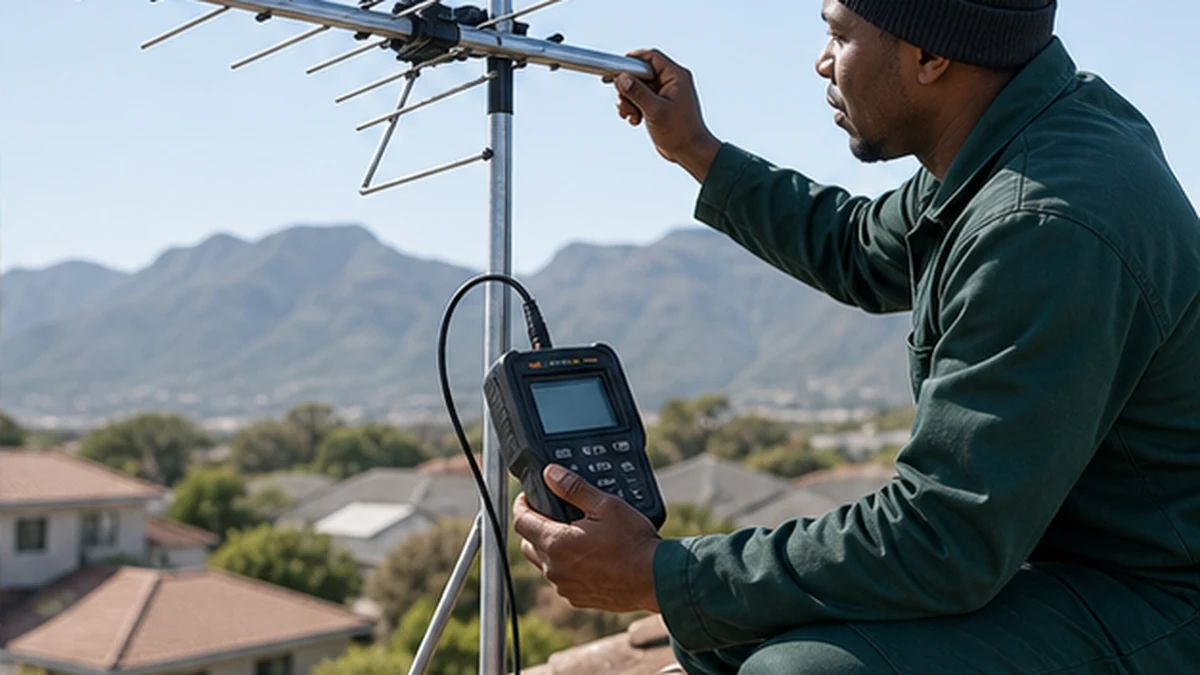
Terrestrial television needs a local signal check
A TV aerial receives terrestrial broadcasts, so its performance depends on available local coverage, position, height, direction and the cable path to the television. Our Kommetjie TV aerial installation service begins with an assessment rather than assuming that a larger aerial will solve every reception problem.
We inspect existing equipment where present and discuss which televisions need a feed. Channel availability is controlled by broadcasters and local transmission conditions, not by the aerial installer.
Choosing a practical mounting position
The aerial needs a stable fixing point with a useful reception path. More height can help in some situations, but an unnecessarily exposed mast can create wind-loading and maintenance problems. Around Slangkop and the Kom area, the building shape and surrounding terrain must be considered together.
We choose a position that balances measured reception, secure mounting, cable distance and safe future access.
Coastal-grade installation details
Salt air, moisture and strong wind are hard on exposed brackets, masts and connectors. We inspect fastening points, use suitable outdoor components for the agreed installation and weather-protect external connections. Loose cable is clipped so it cannot rub repeatedly against the building.
If your issue involves a satellite dish rather than an aerial, dish realignment and repairs is the correct service. The two systems use different reception equipment.
Cabling, outlets and more than one television
Coaxial cable condition affects the picture delivered indoors. We avoid crushed cable, sharp bends and unnecessary joins. Existing wall points and splitters are tested before reuse, because an old distribution fault can look like poor aerial reception.
For several televisions, signal levels and losses need to be considered before adding splitters or amplification. Equipment is selected only where measurements and the planned layout support it.
Tuning and testing at the screen
After the aerial and cable path are set, we tune or retune the agreed television where its menu allows and check the available services. We test at the viewing point, not only beside the aerial. This confirms the complete path through cable, connectors and outlets.
When the television is being repositioned, our TV wall mounting service can coordinate the screen location with the aerial lead and other viewing cables.
Aerial TV, Openview and DStv compared
Terrestrial aerial television, Openview satellite reception and DStv are separate systems. They use different equipment and may offer different channels. We ask what you want to receive before recommending work.
For a free-to-air satellite option, see Openview HD installation. Keeping the platforms clear avoids fitting an aerial when the selected service actually needs a satellite dish and decoder.
TV Aerial Installation questions in Kommetjie
We can assess the aerial, direction, mounting, cable, connectors and outlets. The solution depends on measured reception and local broadcast availability.
Often, but every split introduces loss. We assess the number of outlets, cable distances and measured signal before selecting distribution or amplification equipment.
No. An aerial receives terrestrial broadcasts, while Openview and DStv use satellite dishes and compatible decoders. Their alignment and distribution needs differ.
No installer can guarantee every channel. Reception depends on broadcaster availability, local coverage, terrain, interference and compatible television equipment.