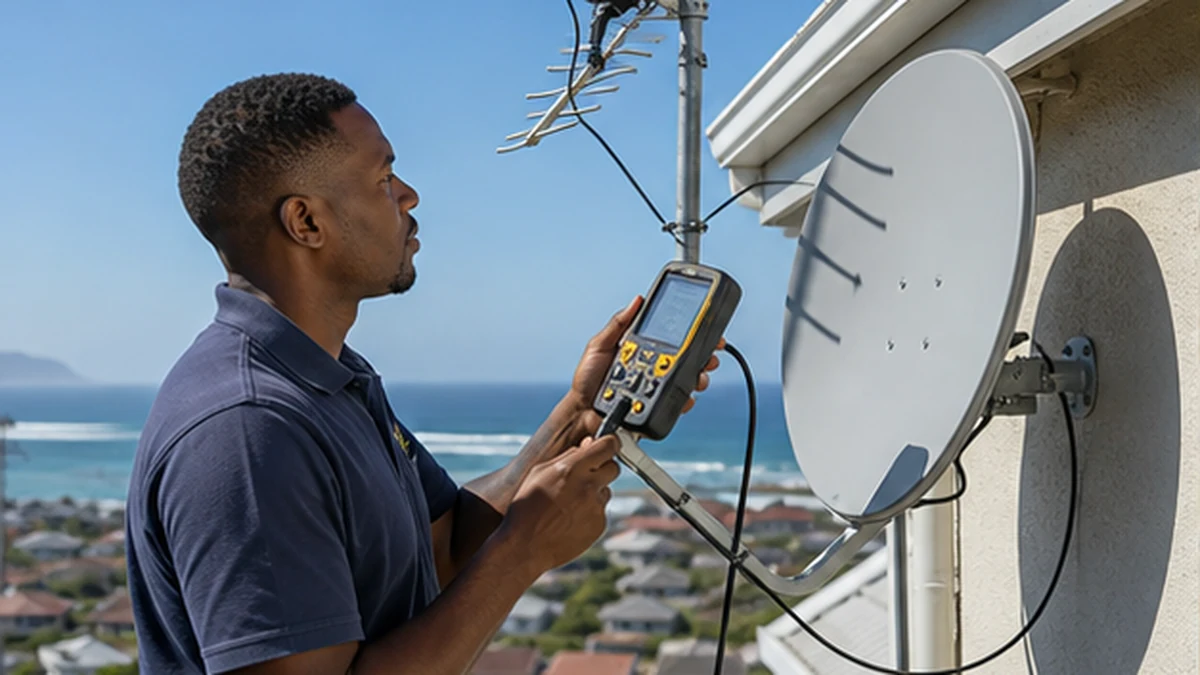
Compare terrestrial TV aerial and satellite reception for channels, equipment, cabling and coastal maintenance.
A TV aerial and a satellite dish receive different broadcast signals. They are not interchangeable pieces of the same system. A terrestrial aerial serves available over-the-air television, while a satellite dish works with a compatible decoder and platform such as DStv or Openview. The right option depends on the channels you need, reception at the property and how the television area is wired. Some Kommetjie homes use both as separate sources.
What a terrestrial TV aerial does
A television aerial receives terrestrial broadcasts available at the property. Performance depends on transmitter coverage, terrain, aerial type, direction, height and the condition of the cable path. An indoor aerial may work in a strong-signal room, while another property needs a correctly selected outdoor aerial. Guessing by the nearest roof is unreliable because buildings and local obstructions differ.
A TV aerial installation should include signal measurements and checks at the television outlet. Amplification is not an automatic cure. Boosting a poor or noisy signal can also boost the problem, so the aerial and cable should be corrected before adding equipment.
What satellite television does
Satellite television uses a dish aligned to the required orbital position, an LNB, satellite-grade coax and a compatible decoder. DStv access depends on the selected account and package. Openview has a different service model and equipment requirements. In both cases, the physical signal path must be sound even when account arrangements are correct.
For DStv, the satellite installation service covers dish placement, alignment, cabling and decoder testing. A provider account problem and a weak satellite signal are different faults. Note the on-screen message and confirm whether all channels or only particular services are affected.
TV aerial vs satellite in Kommetjie weather
Both systems need secure mounting and weather-protected cable entries. Wind can move an aerial or dish, while salt and moisture attack exposed metal and connectors. A dish requires precise alignment. An aerial also needs correct direction and a stable mount, although its reception behaviour differs. Neither should be attached to an unsuitable, failing structure.
Long Beach and Slangkop exposure can differ from a sheltered courtyard in Kommetjie Village. Select the mounting face after testing and access assessment. A sheltered position is useful only if it still receives the intended signal. Keep outdoor joins accessible for service and away from standing water.
Channels, decoders and household use
Begin with the content the household wants. Terrestrial broadcasts may cover essential local free-to-air viewing. Satellite services can provide different channel selections depending on platform and package. Confirm current line-ups with the relevant broadcaster because channels change. Do not choose hardware from an old printed list.
For a holiday property, compare account effort and guest expectations in the Openview vs DStv guide. A household may keep an aerial as an alternative source while using satellite for other viewing. Label television inputs so users know which source is active.
Planning one neat Kommetjie television point
If both aerial and satellite feeds reach the same television, route and label them clearly. Do not use incompatible splitters or force satellite and aerial signals through an unplanned connection. Decide where decoders, wall plates and streaming devices will sit before the screen is mounted. Leave service access to connectors.
A clean finish can be coordinated with TV wall mounting. If the television also streams, test WiFi at the final position. The best setup may combine terrestrial, satellite and internet sources, but each needs its own reliable path and simple user instructions.
Costs and complexity should be compared against the actual viewing need. A household that wants a small set of terrestrial channels should not be pushed towards an unrelated subscription. A family that needs package-specific satellite content should not expect an aerial to reproduce it. Ask the installer to describe each signal source, the equipment it requires and where responsibility moves to the broadcaster or account provider. Keep old remotes and power supplies labelled until the new arrangement is fully tested. Once complete, remove only cables that have been positively identified. An abandoned lead can look identical to a working feed inside a ceiling.
When reception fails, isolate the source before changing settings. Check whether terrestrial channels, satellite channels and internet apps are all affected. If only one source fails, follow that cable and equipment path. A television displaying no input is different from a decoder reporting no satellite signal. Write simple source names into the television menu where supported. Clear labels turn later fault finding into a short sequence rather than a collection of random resets. Keep a small diagram beside the private equipment record. Include the aerial outlet, satellite decoder, internet router and television input names. Note which remote changes each source. This is especially useful after a power interruption, when a screen may restart on an input that the household rarely uses.
Frequently asked questions in Kommetjie
Can a satellite dish replace a TV aerial?
No. They receive different signals and use different equipment. Choose the reception system that matches the service or channels required.
Can one coaxial cable carry both signals?
Combined distribution is a technical design question and needs compatible equipment. Do not join aerial and satellite feeds with an ordinary splitter.
Which is more reliable in Kommetjie weather?
Reliability depends on signal conditions, mounting, alignment, cabling and maintenance. Either system can fail when fittings move or water enters connectors.
Can I have an aerial and satellite at the same television?
Yes. They can remain separate inputs or be integrated through correctly designed equipment, with clear labels and suitable cabling.